Mewing, and what it actually does to your jawline.
A tongue resting on the roof of your mouth isn't a transformation. It's a posture, and like every other posture, it works because you hold it for hours, not minutes.
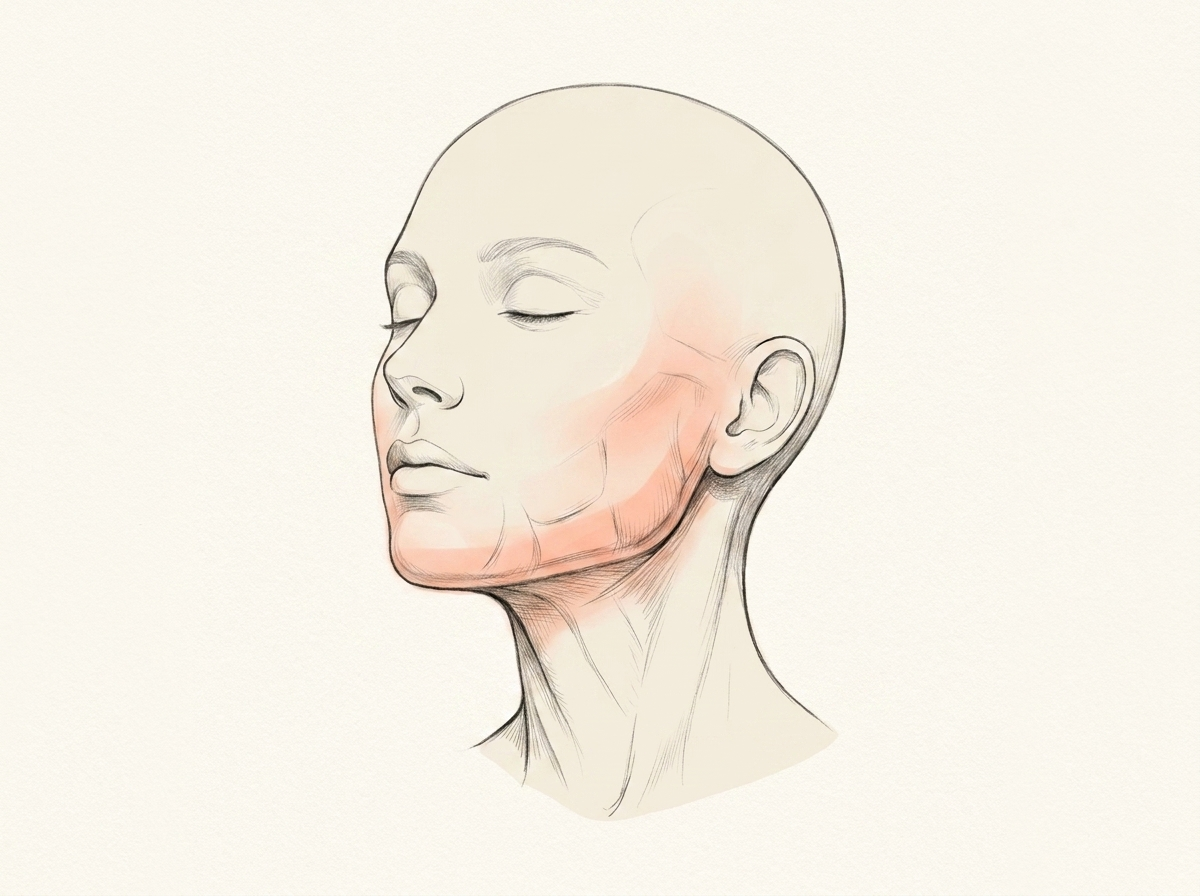
Quick answer
Mewing is resting your entire tongue, not just the tip, flat against the roof of your mouth, with your lips together and teeth lightly touching. The claim is that holding this posture for hours a day supports the jaw and midface. In growing children, oral posture genuinely influences facial development. In adults the effect is real but modest and slow, because the bones have largely set. It's more about muscle habit and carriage than reshaping bone. Mewing is a passive posture, so the results come from duration, not effort. To actively train the facial muscles, that's where measured facial yoga comes in.
The internet has decided that mewing is either a miracle or a meme. The truth, as usual, is duller and more useful: it's a posture. It costs nothing, it can't be done wrong in a way that injures you, and the people most excited about it tend to overstate what it changes.
Here is what mewing actually is, what the evidence supports, and how to know if your version of it is doing anything at all.
What mewing is
Mewing is the practice of resting your tongue against the roof of your mouth (the whole tongue, including the back, flat against the palate) while breathing through your nose with your lips closed and your molars lightly touching but not clenched.
That's it. There's no movement. There's no rep count. You do it whenever you remember to do it, which is the entire difference between mewing working and mewing not working.
The name comes from the British orthodontist John Mew and his son Mike Mew, who argued that modern soft diets have weakened the muscles of the face and jaw, and that holding the tongue against the palate restores tension that the bone responds to. The academic establishment has been less convinced, and the strong-form claims about adult facial restructuring don't have controlled-trial evidence behind them.
But none of that means nothing happens.
The mechanism, if there is one
Two things plausibly change when you hold tongue-up posture consistently.
The first is soft-tissue tone. Your tongue is a muscle. The geniohyoid, mylohyoid, and the suprahyoid group beneath your jaw all engage to hold the tongue in position. Keep them working all day instead of letting the tongue rest on the floor of the mouth, and that area will get firmer, the same way any other muscle responds to load. Whether that produces a visibly sharper submental line depends on how much subcutaneous fat is sitting on top of it.
The second is breathing pattern. When the tongue is up, the mouth tends to close, and breathing shifts to the nose. Nasal breathing engages the diaphragm differently, filters and warms air, and is associated with better sleep quality in mouth-breathers who switch. That's not a face-yoga claim. It's an ENT one.
What mewing almost certainly does not do, in an adult, is restructure the maxilla. The bones of the face are not rebar; they remodel slowly, and the magnitudes claimed in mewing forums aren't supported by the imaging.
Where the practitioners actually agree
Koko Face Yoga treats tongue-up posture as the foundation of their entire method: more important than any individual exercise, on the basis that habits build the face and a three-minute drill cannot undo sixteen waking hours of slack tongue and mouth breathing. Luvly is more cautious: their material acknowledges no thorough study has proven mewing's benefits, and that results are subtle, gradual, and possibly short-term.
Both agree on the form:
- Place the tongue against the roof of the mouth, including the back third, not just the tip.
- Breathe through the nose, with lips closed.
- Let the molars touch lightly. Don't clench. Clenching loads the masseter and can give you the opposite of what you want: a wider, more square lower face.
Both also agree on the failure mode: people mew for a week, see no change in the mirror, and stop. The protocol assumes you do it for months, not days.
What it looks like when it's working
Here is the honest version of the timeline.
In the first two weeks, the only thing you should expect to notice is fatigue under the chin and around the floor of the mouth. That fatigue is the suprahyoid group complaining about being used. It will stop.
By six to eight weeks, the people who hold the posture most of their waking hours sometimes report a subjectively firmer submental area and easier nasal breathing. The mirror change is real but small. Photograph yourself weekly, same lighting, same angle. If you don't see anything at week eight, the posture is probably loose. Most likely the back of your tongue is still down.
Beyond three months, anything else is either weight loss, lighting, or wishful thinking.
Consistency beats intensity. Facial muscles are skin muscles: they respond to load, not strain.
How to know it's actually working
This is the part that mewing has always been bad at, and it's the part Lift-Era exists to fix.
You can't see your own tongue posture. You can't feel the difference between "tongue on the palate" and "tongue pressed firmly on the palate including the back third." Most people who think they're mewing are doing the soft version, which is closer to "not mouth-breathing" than to anything that loads the suprahyoid muscles.
A few honest checks:
- The swallow test. Swallow normally. If your tongue surges forward against your teeth, your resting posture is forward-and-down. If it presses up into the palate, your resting posture is closer to where you want it.
- The mirror check. Profile, mouth closed. Is your chin softening into your neck, or is there a visible line between jaw and neck? The line is partly genetic, but the posture contributes to which version you live with.
- The TrueDepth check. Lift-Era uses your iPhone's depth camera to read the position of your jaw and the contour of your submental area in real time, while you hold the posture. You see a number. The number goes up when the back of your tongue is engaged. It doesn't go up when you cheat. That's the part the internet has been missing.
Facial yoga works. Mewing, in its honest form, is part of it. The question has never been whether the posture matters. It's whether yours is the posture you think it is.
Eight minutes a day, measured. The rest of the day, tongue up.
Frequently asked questions
- Does mewing actually work?
- In growing children, tongue and oral posture clearly influence facial development. This is well established in orthodontics. In adults the bones have largely set, so the plausible effect is modest and slow, more about muscle habit and posture than reshaping the jawline.
- How long does mewing take to show results?
- There is no reliable timeline for adults. Because mewing is a passive posture rather than active training, any change is gradual and subtle, measured in many months of near-constant practice, if it appears at all.
- How do you mew correctly?
- Rest your whole tongue flat against the roof of your mouth, keep your lips gently closed and teeth lightly touching, and breathe through your nose. The key detail most people miss is using the entire tongue, including the back, not just pressing the tip behind the teeth.
- Is mewing the same as facial yoga?
- No. Mewing is a static tongue posture held passively through the day. Facial yoga is active muscle training done in short sessions. They target different systems and work well together.
Try it yourself
The only facial yoga app that tells you if it’s working.
Real-time AI scoring on your iPhone’s TrueDepth camera. Eight minutes a day, on-device, no guesswork.
See how it works